
Davenport, Bettendorf and both sides of the river
Spray Foam Insulation in Davenport, IA
Closed-cell and open-cell foam where it pays, blown-in where it costs less, all priced in writing after we see your house.
- Free on-site estimates
- Written quote with foam type, thickness and R-value per area
- Leaks, wiring and damp spots flagged before anything gets covered
Built for River-Town Winters
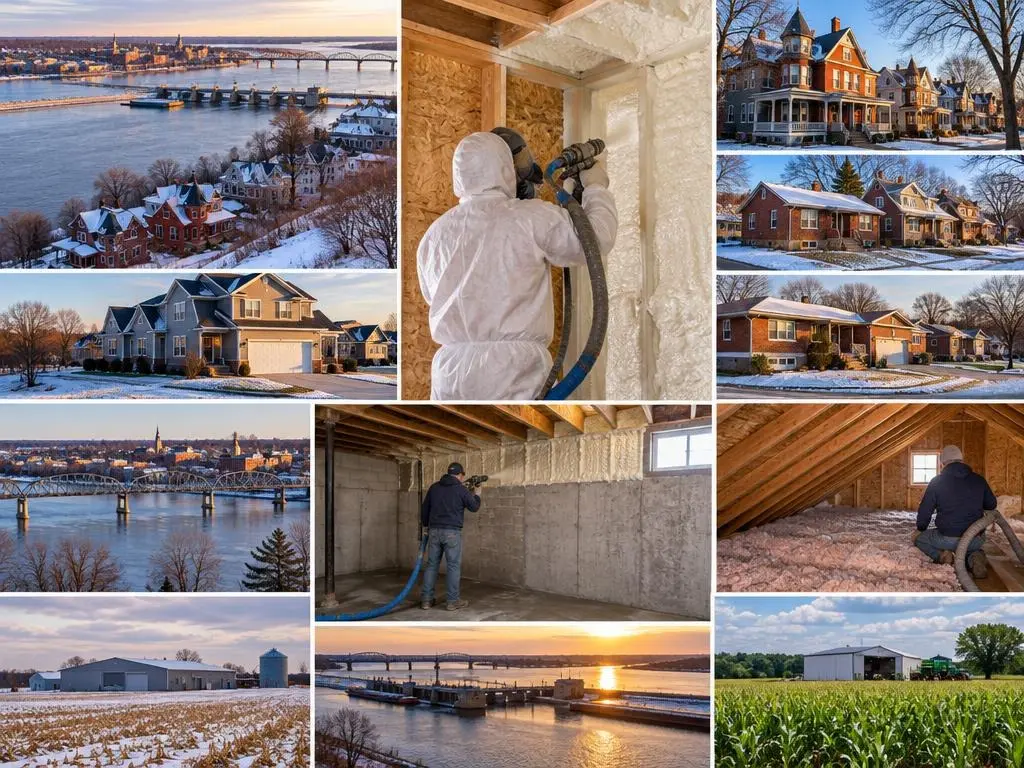
Spray foam insulation in Davenport has a lot of old houses and cold air to deal with. Census estimates compiled by Point2Homes show that 24% of the city's homes were built in 1939 or earlier, and Wikipedia's climate section puts Davenport's record low at -29F on January 18, 2009, with about 30.7 inches of snow in an average year. We seal the air leaks and insulate the attics, basements, walls and outbuildings that let that cold in, using closed-cell or open-cell spray foam where it makes sense and blown-in insulation where it does the same job for less.
What the code asks for here
Scott County sits in Climate Zone 5A on OpenEI's county list, along with Rock Island, Henry, Clinton and Muscatine counties. Iowa's residential energy code is the 2012 IECC with state amendments, and the Iowa table sets R-49 for ceilings in Zones 4 through 8 and R-20 (or R-13 plus R-5 continuous) for wood-frame walls in Zones 3 through 6. On the Illinois side, the state's Capital Development Board says the 2024 IECC, as amended by Illinois, took effect on November 30, 2025. Iowa's rule also says the remodeling or renovation of one- and two-family homes is outside the code's scope, so for an older house the code numbers are a useful target rather than a mandate. We write the target R-value for each area on the quote either way.
Where Quad Cities houses leak
The housing here spans more than a century. Davenport was founded in 1836 and grew steadily for over a hundred years, and the old German neighborhoods in the center and west of the city still hold workers' cottages, two-story frame houses and the large Queen Anne and Tudor Revival homes around Vander Veer Park, built between 1895 and 1915. Point2Homes data also shows big building waves in the 1960s (13.5% of homes) and 1970s (15.1%). Each era leaks in its own way. Pre-war houses often have open framing that runs from the basement to the attic, so warm air rises straight out of the house. Story-and-a-half homes lose heat through kneewalls and the short attic floors behind them. Ranches and split-levels from the 1960s and 1970s usually have a full basement with a bare rim joist all the way around. Newer houses are tighter but still leak at attic hatches, recessed lights and rooms over garages.
Closed cell vs open cell
Open-cell foam is soft and light, at about R-3.5 to R-3.7 per inch according to HomeGuide. It expands to fill a cavity and stops air well, but water vapor can pass through it, so in a cold climate it needs a vapor plan. Closed-cell foam is rigid and dense, at R-5 to R-7 per inch, and at normal thickness it slows vapor and does not soak up water. In the Quad Cities that makes closed-cell the usual choice for rim joists, basement walls, crawl spaces, steel buildings and roof decks with no room for venting. Open-cell works in interior walls and some attic rooflines where moisture is handled another way. On a big open attic floor, we usually seal the gaps with foam and blow cellulose or fiberglass on top, because that costs less per R-value.
Basements in a river town
Davenport is the largest city on the Mississippi without a permanent flood wall or levee, according to Wikipedia, and the river crested at 22.63 feet in the 1993 flood, almost 8 feet over flood stage. Duck Creek has flooded parts of Davenport and Bettendorf too. Most homes are nowhere near the river, but plenty of basements here have taken on water at some point. That changes how we insulate them. We do not bury damp walls behind fiberglass. Closed-cell foam on the rim joist and on dry foundation walls insulates without giving water something to soak into, and if we find active seepage, we tell you to deal with it first.
Spray foam insulation contractors: what to ask
When you call spray foam insulation contractors or insulation companies around Davenport, ask the same handful of questions of each one. What will they seal before they insulate? Which foam goes where, at what thickness and R-value? How will they handle the attic ventilation and the cold-weather timing? How long will the household need to stay out while it cures (HomeGuide suggests 24 hours or more)? What happens to old insulation that is wet or full of debris? A careful company answers in writing. Ours does, area by area, so you can compare bids on equal terms.
Spray foam insulation cost
HomeGuide's 2026 guide puts installed spray foam at $1.50 to $5.00 per square foot, with open-cell at $1.50 to $3.50 and closed-cell at $3.00 to $5.00. Fixr's figures for an existing home run $3.15 to $7.50 per square foot. A rim joist job typically lands around $2,000 to $2,500 (HomeGuide), and an average attic insulation job runs $1,000 to $2,700. These are national ranges. In the Quad Cities, the age of the house matters a lot: old attics often need cleanup and air sealing first, and basements with flood history may need moisture work before insulation. We price your job after seeing it, and the written estimate is what you pay.
Utility rebates
If MidAmerican Energy is your Iowa utility, its 2026 residential program terms say equipment must be bought, installed and running between January 1 and December 31, 2026, that applications are due within 90 days of the invoice, and that a prescriptive rebate cannot be more than 70% of the equipment cost (labor does not count). Program details change each year, so check the current list before you schedule work, and keep your invoice. Get a free estimate
Why Homeowners Call Spray Foam Insulation Davenport
A real look before a price
We go into the attic and the basement or crawl space and measure before we write a number down.
Air sealing comes first
Top plates, chases, penetrations and the rim joist get sealed before new insulation covers them.
The material fits the spot
Closed-cell, open-cell, cellulose or fiberglass, picked for the surface and the moisture risk, with the reason on the quote.
Quotes you can compare
Each area lists material, thickness or depth, target R-value and price.
Common Questions
How much should I expect to pay for spray foam insulation?
HomeGuide's 2026 national range is $1.50 to $5.00 per square foot installed, with closed-cell at the high end. Fixr lists $3.15 to $7.50 per square foot for existing homes. Many small jobs hit a minimum of $1,000 to $2,000 or more. We give you a written price after we see the space.
How much does it cost to spray foam about 1,500 square feet?
It depends on the foam and the thickness. At HomeGuide's $1.50 to $5.00 per square foot, 1,500 square feet of surface works out to roughly $2,250 to $7,500 before any prep, removal or extra thickness. Attic floors are often cheaper with blown-in on top of sealed gaps.
Why do some people call spray foam a red flag?
Usually because of bad installs: foam sprayed over roof leaks or damp wood, foam that hides rot, or off-ratio foam that smells. The fix is careful prep, a dry surface, the right foam for the spot and proper curing time. We check for leaks and moisture first and tell you how long to stay out.
What R-value do I need in a Davenport attic?
Iowa's energy code table sets R-49 for ceilings in Climate Zone 5, which covers Scott County. For an older house the code is a target rather than a requirement, since Iowa's rule leaves remodels of one- and two-family homes out of its scope. Most attics we see here are well short of R-49.
How much would it cost to spray foam a 20x20 garage?
A 20x20 garage has about 400 square feet of floor, but you insulate walls and ceiling, which can be 1,000 square feet or more of surface. At HomeGuide's ranges, that is roughly $1,500 to $5,000 for closed-cell or open-cell foam, and small jobs often hit a minimum. We measure and quote it in writing.
Can you insulate a basement that has flooded before?
Yes, once it is dry and the water source is handled. We use closed-cell foam on the rim joist and dry foundation walls because it does not soak up water. Any insulation that got wet in a past flood should come out first.
Towns We Cover on Both Sides of the River
We work in Davenport, Bettendorf, Eldridge and Le Claire in Scott County, DeWitt to the north and Muscatine down the river, and across the bridges in Moline, Rock Island, East Moline, Silvis and Milan, with Geneseo to the east. The older river cities hold the most pre-war houses with open framing and stone or block foundations. Bettendorf and the growing Scott County towns have more 1960s-to-2000s homes with full basements and attached garages. The farm country around DeWitt, Eldridge and Geneseo adds machine sheds and shops. Each town page covers what is different there.
- Spray Foam Insulation in Davenport, IA
- Spray Foam Insulation in Bettendorf, IA
- Spray Foam Insulation in Moline, IL
- Spray Foam Insulation in Rock Island, IL
- Spray Foam Insulation in East Moline, IL
- Spray Foam Insulation in Silvis, IL
- Spray Foam Insulation in Milan, IL
- Spray Foam Insulation in Eldridge, IA
- Spray Foam Insulation in Le Claire, IA
- Spray Foam Insulation in DeWitt, IA
- Spray Foam Insulation in Geneseo, IL
- Spray Foam Insulation in Muscatine, IA
What We Insulate
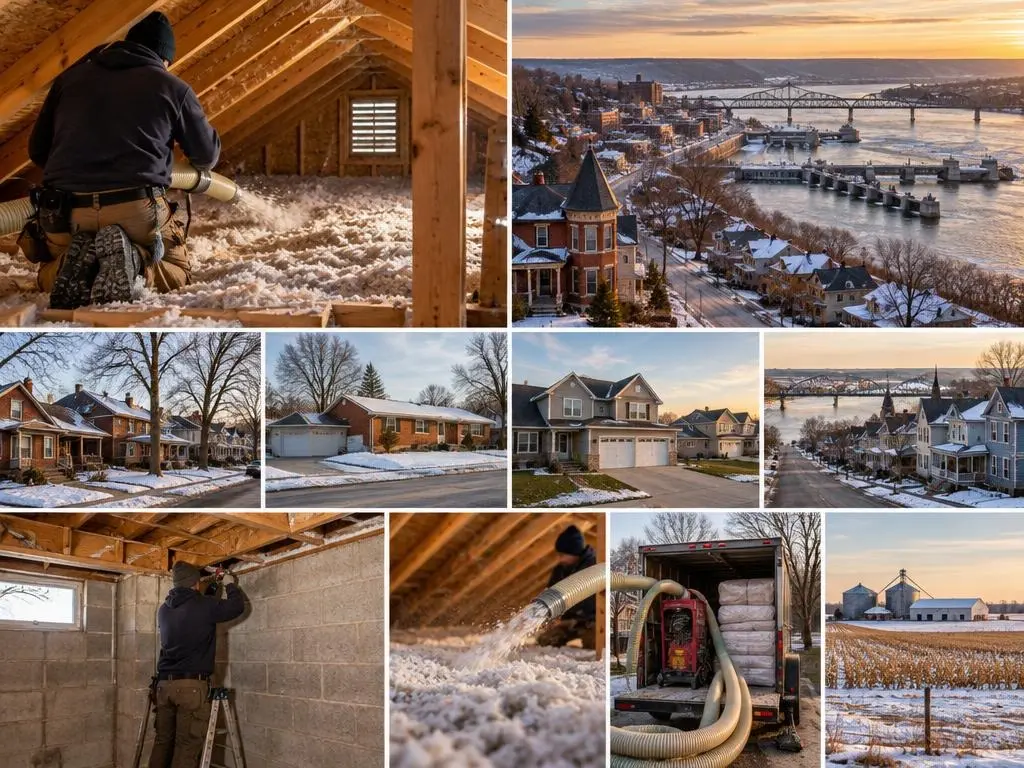
Six kinds of work, matched to each part of the house or building, from foam on a basement rim joist to clearing out flood-soaked insulation.
Spray Foam Insulation
Closed-cell and open-cell foam that insulates and seals air in one layer, for rim joists, walls, rooflines and steel buildings.
Learn more →Attic Insulation & Air Sealing
Sealing the gaps that leak warm air into the attic, then bringing the insulation up to depth.
Learn more →Basement & Rim Joist Insulation
Closed-cell foam on the rim joist and basement walls to stop drafts and cold floors.
Learn more →Blown-In Insulation
Loose-fill cellulose or fiberglass blown into attics and closed walls to reach full depth at a lower cost.
Learn more →Pole Barn & Garage Insulation
Spray foam for pole barns, machine sheds, shops and garages that stops drips and holds heat.
Learn more →Insulation Removal & Replacement
Taking out wet, flood-soaked, moldy or rodent-soiled insulation and putting in new.
Learn more →Get a Written Insulation Quote
We come out, check the attic and basement, and send a written price for each area.