
Closed-cell and open-cell foam
Spray Foam Insulation in Davenport, IA
Dense foam where cold and moisture meet the house, lighter foam where air sealing and sound matter more.
- Free on-site estimates
- Written quote with foam type, thickness and R-value per area
- Leaks, wiring and damp spots flagged before anything gets covered
Two Foams, Two Jobs
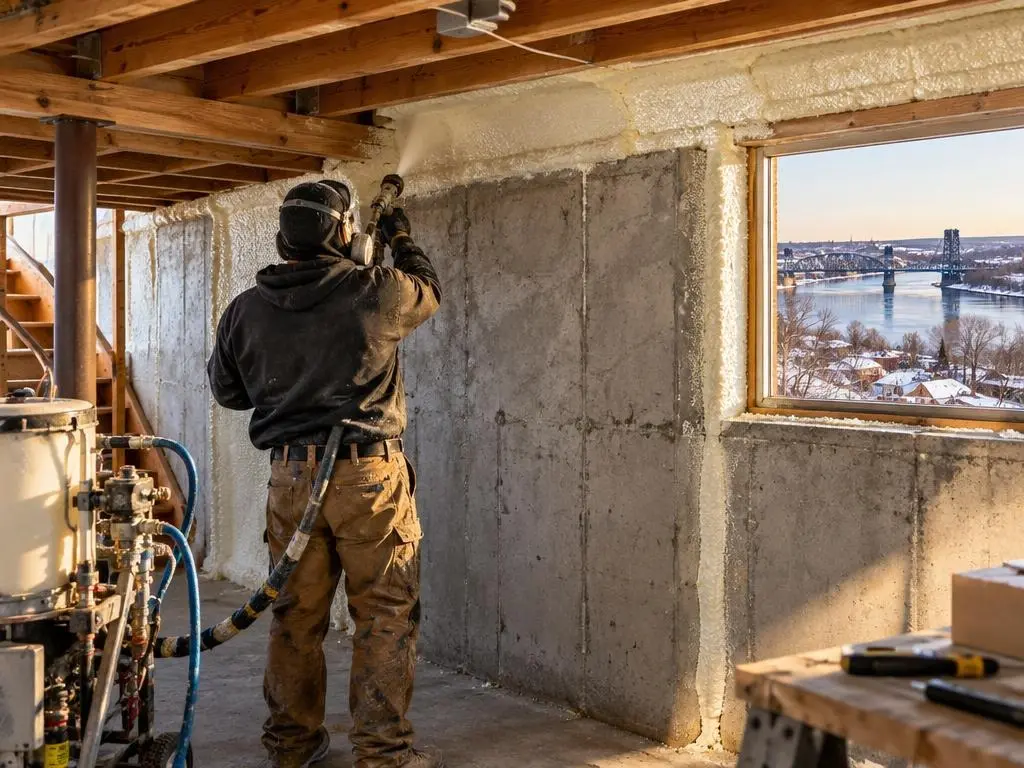
Spray foam insulation goes on as a liquid, expands into every crack and cures in place, so it insulates and seals air in a single pass. In Davenport, where Wikipedia's climate section lists an average of about 30.7 inches of snow a year and a record low of -29F, that seal matters as much as the R-value. Foam does its best work where cold air and moisture meet the house: rim joists, basement walls, kneewalls, cathedral ceilings and steel buildings. We spray two kinds, and picking between them is the first decision on every job.
Closed cell vs open cell
Closed-cell foam cures hard and dense. HomeGuide rates it at R-5 to R-7 per inch, and at typical thickness it slows water vapor and does not absorb water. It also stiffens the surface it is sprayed on. Open-cell foam is softer and expands much more, at R-3.5 to R-3.7 per inch. It seals air well and quiets sound, but vapor can pass through it, so in Climate Zone 5 it needs a vapor retarder on the warm side or an assembly that can dry.
In the Quad Cities, that steers closed-cell toward the cold, damp places: rim joists, foundation walls, crawl spaces, roof decks over vaulted ceilings and the steel in shops and pole barns. Open-cell fits interior walls, floors between heated rooms, and some attic rooflines where moisture is handled.
Thickness and the code target
Iowa's residential code table lists R-20, or R-13 plus R-5 continuous, for wood-frame walls in Zone 5 and R-49 for ceilings. Closed-cell foam reaches high R-values in a few inches, which matters in a 2x4 wall or a shallow roof bay. In a roof with no attic, it is hard to reach a high R-value with batts and still leave a vent channel, and that is a common reason to use closed-cell against the deck. We size the thickness to the target and write both numbers on the quote.
The rim joist: our most common foam job
The rim joist is the band of wood that sits on top of the foundation and carries the floor framing. In most Quad Cities basements it is bare wood or has a little fiberglass stuffed against it, and it leaks cold air all the way around the house. Two to three inches of closed-cell foam seals and insulates it in one step. If you are finishing a basement, this is the time to do it, before framing and drywall go up.
Older houses
Davenport's pre-war houses, and the ones across the river in Moline and Rock Island, often have open cavities that run between floors and act like chimneys for warm air. Foam is a practical way to close those at the top and bottom. We also foam kneewalls and the attic floor behind them in story-and-a-half homes, cantilevered floors and the floors of rooms over garages.
When foam is the wrong call
Foam does not fix a leak. If a roof, window or plumbing leak is wetting the framing, it has to be repaired first or the foam will hide the damage. Foam should not go over knob-and-tube wiring or vermiculite that may contain asbestos until those are dealt with. And on a wide-open attic floor, sealing the gaps and blowing loose fill on top usually costs less. We tell you which parts of the house are worth foaming and which are not.
Curing and getting back in
We cover floors and belongings, mask windows and outlets, and set up ventilation before we spray. HomeGuide advises staying out for 24 hours or more while foam cures. Foam also needs the surface and the material within a working temperature range, so for cold attics and unheated buildings in winter we add heat or wait for a better day. Once cured, foam does not settle or sag. Get a free estimate
Where Spray Foam Goes
The spots we foam most often and the foam we usually choose.
Closed-cell foam
Dense foam at R-5 to R-7 per inch (HomeGuide) for rim joists, foundation walls, crawl spaces and steel.
Open-cell foam
Lighter foam at R-3.5 to R-3.7 per inch for interior and above-grade cavities with a vapor plan.
Rim joists
Foam on the wood band above the foundation to stop drafts around the whole basement.
Kneewalls and bonus rooms
Sealing and insulating the walls and floors around upstairs rooms and rooms over garages.
Roof decks and vaulted ceilings
Closed-cell under the roof deck where there is no attic or no room for a vent channel.
Open walls in remodels and additions
Stud bays filled to the wall target while they are open.
Steel shops and pole barns
Foam on roof and wall steel to insulate and stop condensation drip.
Published Spray Foam Costs
| Job | Range and source |
|---|---|
| Spray foam, installed | $1.50 to $5.00 per sq ft (HomeGuide) |
| Open-cell / closed-cell | $1.50 to $3.50 / $3.00 to $5.00 per sq ft (HomeGuide) |
| About 1,000 sq ft | $1,500 to $5,000 (HomeGuide); $3,150 to $7,500 existing home (Fixr) |
| Existing walls / new construction | $3.15 to $7.50 / $2.75 to $6.50 per sq ft (Fixr) |
| Attic | $3,000 to $8,000 (HomeGuide) |
| All exterior walls | $4,000 to $10,000 (HomeGuide) |
| Whole house | $8,000 to $20,000 (HomeGuide); $10,000 to $30,000 (Fixr) |
| Typical job minimum | $1,000 to $2,000+ (HomeGuide) |
Our written quote is the price you pay. These are national ranges from HomeGuide (2026) and Fixr (2025); foam type, thickness, access and prep set the final number.
How a Foam Job Runs
1. Visit and inspect
We look at each space, check for leaks, damp wood, old wiring and vermiculite, and measure.
2. Written quote
Each area lists foam type, thickness, target R-value and price.
3. Prep
We cover and mask, set up ventilation and make sure the space is warm enough to spray.
4. Spray
Foam goes on in passes to the planned thickness and gets trimmed where needed.
5. Walk-through
We clean up, show you the work and tell you when the space is ready to use.

Why Choose Us for Spray Foam Insulation
Foam only where it pays
If blown-in or simple air sealing does the job for less, we say so.
Thickness on paper
The quote names thickness and R-value so you can compare bids fairly.
Problems first
Leaks, wiring and suspect vermiculite get flagged before anything is covered.
Spray Foam Insulation Questions
Which type of spray foam has the highest R-value?
Closed-cell, at about R-5 to R-7 per inch according to HomeGuide, compared with R-3.5 to R-3.7 for open-cell. That is why closed-cell is used where space is tight, like rim joists and shallow roof bays.
What are the downsides of closed-cell spray foam?
It costs more per square foot, it is hard to remove later, and it needs careful installation and curing time. It is also overkill on a wide-open attic floor where blown-in does the job for less.
Can spray foam go in during an Iowa winter?
In heated basements, yes. Cold attics and unheated buildings need the surface and the foam within a working temperature range, so we add heat or pick a milder day.
Does spray foam stop moisture?
Closed-cell foam slows vapor and keeps warm, damp air off cold surfaces where it would condense. It is not waterproofing and does not fix a leak, so leaks get repaired first.

Spray Foam Insulation Service Areas
- Spray Foam Insulation in Davenport, IA
- Spray Foam Insulation in Bettendorf, IA
- Spray Foam Insulation in Moline, IL
- Spray Foam Insulation in Rock Island, IL
- Spray Foam Insulation in East Moline, IL
- Spray Foam Insulation in Silvis, IL
- Spray Foam Insulation in Milan, IL
- Spray Foam Insulation in Eldridge, IA
- Spray Foam Insulation in Le Claire, IA
- Spray Foam Insulation in DeWitt, IA
- Spray Foam Insulation in Geneseo, IL
- Spray Foam Insulation in Muscatine, IA
Get a Spray Foam Insulation Estimate
Tell us which spaces you are thinking about. We will look and send a written foam plan and price.